
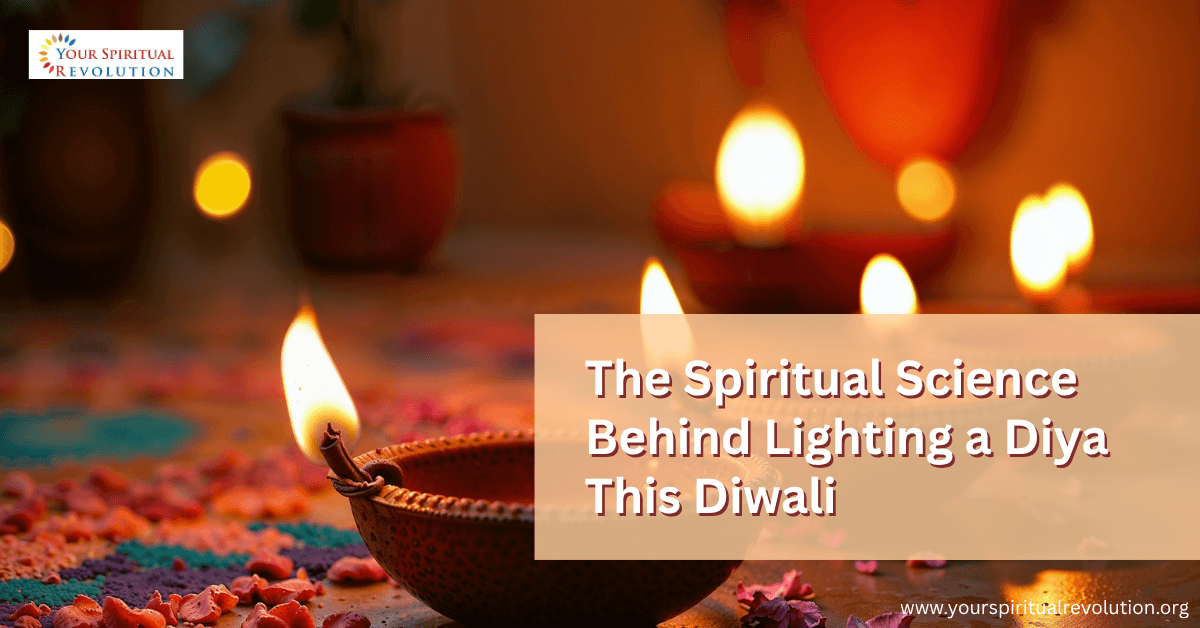

The Spiritual Science Behind Lighting a Diya This Diwali

The Spiritual Science Behind Lighting a Diya This Diwali

Every year, right around Diwali, something quietly shifts in households across India and beyond. Rows of small clay diyas appear on windowsills, balconies, and doorsteps, flickering against the dark in a way that feels almost stubborn — as if light itself were making a small, repeated argument against everything heavy the year has carried.

Most people light a diya because it’s tradition. Few stop to ask why this particular act — not a bonfire, not electric fairy lights, but a small flame in a clay cup — has survived thousands of years of change. The answer turns out to be less about religion and more about something close to healing.

Fire as the Oldest Form of Reset

Long before Diwali became associated with festivity, fire held a simpler role in human life: it marked endings and beginnings. A fire that burned through the night meant safety until morning. A flame passed from one hearth to another meant continuity — a household surviving, a lineage continuing.

The diya carries a smaller, gentler version of that same symbolism. Lighting one is less about illuminating a room and more about marking a transition — closing one chapter of the year, however difficult, and opening a new one with intention rather than exhaustion. This is likely why Diwali, more than almost any other festival, is treated as a kind of emotional reset button. People clean their homes obsessively in the days before. They settle old debts, resolve old arguments, throw out what they no longer need. The diya is simply the final, physical gesture in a much larger process of letting go.

Why the Flame, Specifically, Feels Calming

There’s a reason staring at a flame — any flame — tends to quiet a restless mind. Fire moves in a way nothing else does: unpredictable, yet strangely rhythmic. Psychologically, this kind of gentle, irregular motion has a documented calming effect, similar to watching water or clouds. It gives the mind something to rest on without demanding focus.

Add to this the ritual act of lighting the diya yourself — striking a match, cupping a hand around the flame, watching it catch — and you have a small, deliberate moment of presence built into an otherwise chaotic festival season. In a time of year that’s often loud, bright, and overstimulating, the five seconds it takes to light a single diya might be the quietest, most grounding moment many people experience all week.

The Overlooked Role of Scent

Diyas are rarely lit alone. Most homes pair them with dhoop or incense, and this combination isn’t accidental. Scent reaches the brain’s limbic system faster and more directly than almost any other sense, which is part of why certain fragrances — sandalwood, guggal, camphor — can shift someone’s emotional state almost instantly. The specific scents used during Diwali aren’t random either; they’ve been chosen, refined, and passed down over centuries precisely because they’re associated with calm, clarity, and a sense of sacredness.

Together, light and fragrance create a small sensory ritual that does something most people don’t consciously register: it tells the nervous system to stand down, even briefly, in the middle of a loud, high-energy festival.

A Ritual That Asks for Almost Nothing

What makes the diya genuinely remarkable is how little it demands. No elaborate setup, no special training, no financial investment beyond a few rupees of clay and oil. Anyone — regardless of how chaotic their year has been, how far they live from family, or how uncertain their circumstances — can light one and participate in something that has quietly healed people for generations. This Diwali, before the fireworks start and the sweets come out, it might be worth pausing at just one diya. Not to perform a ritual correctly, but to actually notice it — the small flame, the faint scent of dhoop drifting nearby, the five seconds of stillness it creates. That tiny act of light, repeated by millions of hands at once, may be the oldest, simplest form of healing this festival has ever offered.
About The Author
Share:

Leave a Reply

Leave A Comment*

We'd love to hear from you!

Recent Blogs

The Sacred Rays of God

The Sacred Rays of God

Introduction My memory remains vivid across dimensions and lifetimes—standing on the crystalline shores of Venus,