
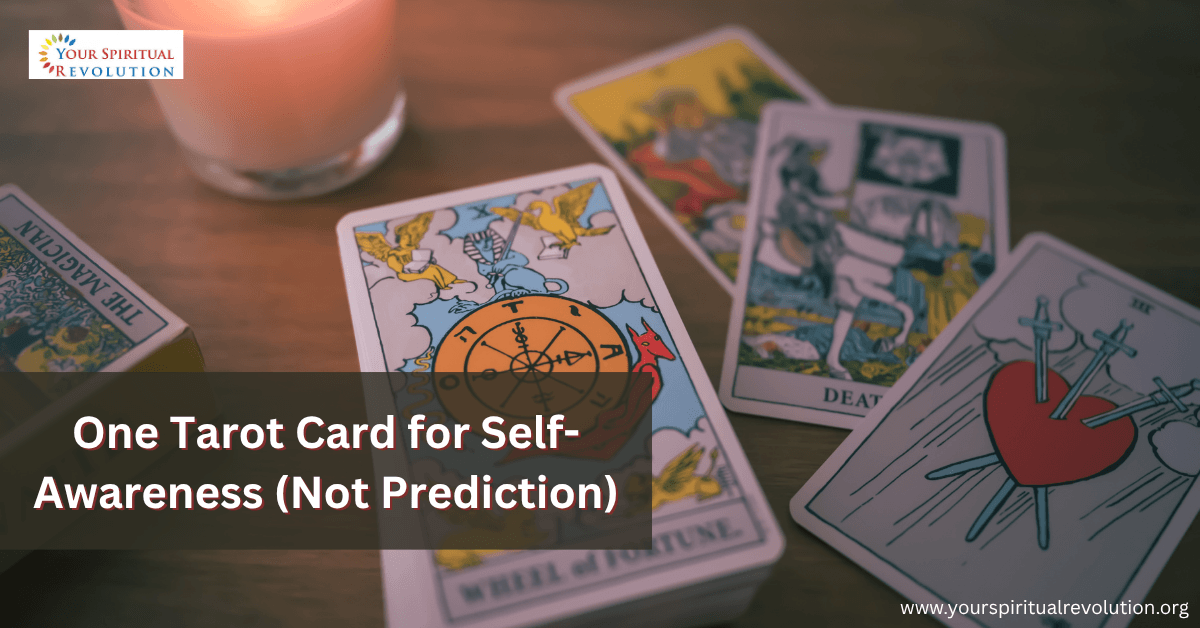



Tarot works best as a mirror. You ask one honest question, sit with one card, and notice what it reflects—an attitude, a knot you have been ignoring, a next move you were already circling. It works worst as a verdict machine: Will they text? Will the job land? Is the path sealed?
Spiritual self-awareness belongs to the mirror. You are not trying to extract certainty from cardboard. You are trying to catch your own pattern early enough to choose a cleaner response before the day runs on autopilot.
That difference sounds small. In practice it changes what you ask, how long you look, and whether you walk away with a step—or with another loop.
Spiritual self-awareness belongs to the mirror. You are not trying to extract certainty from cardboard. You are trying to catch your own pattern early enough to choose a cleaner response before the day runs on autopilot.
That difference sounds small. In practice it changes what you ask, how long you look, and whether you walk away with a step—or with another loop.
Treat one card like a daily habit, not a crisis tool
Most people reach for a deck when something already hurts. That is understandable, and it is also why the draw turns loud: the question arrives loaded with fear, and every image starts looking like a verdict.
A quieter use is better for self-awareness. Pick a fixed slot—morning coffee, the commute pause, or the ten minutes before sleep—and draw one Major Arcana card for that window only. Keep the attention short. The rule stays stubborn: one question, one card, one next step. Skip the emergency stack of redraws.
Morning questions tend to work when they aim at tone, not outcome:
A quieter use is better for self-awareness. Pick a fixed slot—morning coffee, the commute pause, or the ten minutes before sleep—and draw one Major Arcana card for that window only. Keep the attention short. The rule stays stubborn: one question, one card, one next step. Skip the emergency stack of redraws.
Morning questions tend to work when they aim at tone, not outcome:
- “What stance helps me through today’s hardest conversation?”
- “Where am I likely to over-give before noon?”
- “What would ‘enough effort’ look like by evening?”
Night questions work when they aim at release, not scorekeeping:
- “What am I still gripping that does not need a decision tonight?”
- “Which worry belongs to tomorrow’s calendar, not this pillow?”
- “What is one kind thing I can do for my body before I sleep?”
Keep the window short on purpose. “This month,” “this relationship forever,” and “my whole career” invite the cards to play fortune-teller. “Before lunch,” “this evening,” and “before I send that message” keep the practice inside your actual day.
If you only remember one edit: cut every clause about other people’s secret motives. Keep verbs you own—speak, wait, prepare, decline, rest. If the page is empty after that cut, you were asking the cards to manage someone else’s mind. That job is out of scope. One question. One draw. If you dislike the card, sit with it or rephrase tomorrow. A stack of redraws usually means you wanted a prettier reflection, not a clearer one.
A useful test for whether the habit is working: after a week, can you name two patterns that showed up more than once? Maybe you keep drawing cards that ask for pause. Maybe you keep writing questions about other people’s feelings. That second pattern is information too—it tells you where your attention leaks. You do not need a perfect streak. You need enough repetition that your own defaults become visible.
If you only remember one edit: cut every clause about other people’s secret motives. Keep verbs you own—speak, wait, prepare, decline, rest. If the page is empty after that cut, you were asking the cards to manage someone else’s mind. That job is out of scope. One question. One draw. If you dislike the card, sit with it or rephrase tomorrow. A stack of redraws usually means you wanted a prettier reflection, not a clearer one.
A useful test for whether the habit is working: after a week, can you name two patterns that showed up more than once? Maybe you keep drawing cards that ask for pause. Maybe you keep writing questions about other people’s feelings. That second pattern is information too—it tells you where your attention leaks. You do not need a perfect streak. You need enough repetition that your own defaults become visible.
Look first, then add your real day
Give the image half a minute without the booklet. Open or closed posture? Stuck or moving? What feels heavy—barrier, load, empty road?
Say something blunt out loud if you need to: “This looks like carrying too much,” or “This looks like turning away.” Then let a traditional meaning in as a maybe—”this may point toward patience”—not a proof. Prefer the reading that suggests a behavior you can test before tomorrow, not the one that only flatters you.
Add one private fact: the draft message, the meeting you dread, the sleep you keep skipping. Without that line, every card stays a poster. With it, the same image becomes a lens on this afternoon.
Major Arcana cards are blunt enough for this kind of daily work. A few examples of how the mirror can sound when you refuse prediction language: The Hermit. People jump to “you will be alone.” A working version is quieter: step back from the group chat for an hour; write the decision privately before you ask three friends to vote on your life. Temperance. This is not a promise that balance will magically arrive. It may mean stop pouring a second reaction into a fight that already has enough heat—or mix one practical task with one rest break instead of swinging between overwork and collapse. The Chariot. Not “you will win.” Pick one direction for the next two hours and stop renegotiating it every ten minutes.
The Moon. The dramatic read says “someone is lying.” The useful read is often that your anxiety is filling gaps with stories. Wait for daylight—or one verified fact—before you send the long message. Strength. Skip “be tougher.” Hold the urge gently: feed the dog, drink water, finish the email without the last sharp paragraph.
None of these readings certify the future. They name a pattern you can test. If a meaning only flatters you, or only terrifies you, try the quieter reading that still asks for a behavior. Example from an ordinary day: a vague text has you spinning. Your morning question was about tone. Temperance on the table is not a forecast that they will reply tonight. It may mean wait until you have eaten, or ask one clear thing instead of a speech that tries to settle every score.
Another ordinary evening: you keep replaying a meeting. The Moon appears. The useful move is often not “decode the symbolism for an hour.” It is to write the three facts you actually know, leave a blank for what you do not, and sleep. Self-awareness here is the refusal to decorate uncertainty with a story that feels more dramatic than the evidence.
Add one private fact: the draft message, the meeting you dread, the sleep you keep skipping. Without that line, every card stays a poster. With it, the same image becomes a lens on this afternoon.
Major Arcana cards are blunt enough for this kind of daily work. A few examples of how the mirror can sound when you refuse prediction language: The Hermit. People jump to “you will be alone.” A working version is quieter: step back from the group chat for an hour; write the decision privately before you ask three friends to vote on your life. Temperance. This is not a promise that balance will magically arrive. It may mean stop pouring a second reaction into a fight that already has enough heat—or mix one practical task with one rest break instead of swinging between overwork and collapse. The Chariot. Not “you will win.” Pick one direction for the next two hours and stop renegotiating it every ten minutes.
The Moon. The dramatic read says “someone is lying.” The useful read is often that your anxiety is filling gaps with stories. Wait for daylight—or one verified fact—before you send the long message. Strength. Skip “be tougher.” Hold the urge gently: feed the dog, drink water, finish the email without the last sharp paragraph.
None of these readings certify the future. They name a pattern you can test. If a meaning only flatters you, or only terrifies you, try the quieter reading that still asks for a behavior. Example from an ordinary day: a vague text has you spinning. Your morning question was about tone. Temperance on the table is not a forecast that they will reply tonight. It may mean wait until you have eaten, or ask one clear thing instead of a speech that tries to settle every score.
Another ordinary evening: you keep replaying a meeting. The Moon appears. The useful move is often not “decode the symbolism for an hour.” It is to write the three facts you actually know, leave a blank for what you do not, and sleep. Self-awareness here is the refusal to decorate uncertainty with a story that feels more dramatic than the evidence.
Take one step you control—then stop
Name a step that does not require anyone else’s permission to count:
If the “step” still needs their yes, rewrite it until it does not. Then close the deck or the tab. Pulling again “just to confirm” is usually reassurance shopping.
A simple close ritual helps the habit stick. Write one sentence in a note: question, card name, step. That is enough. You do not need a journal essay. Tomorrow’s draw can stand on its own without you auditing last week’s performance. Used this way, tarot supports personal insight and reflection. It is not medical, legal, or financial advice, and it cannot certify what someone else feels. If you are in acute distress, talk to a qualified human—cards are a mirror for ordinary self-observation, not a substitute for care.
If you want a simple online frame for the same habit—one question, one card, one next step—a free one card tarot draw can hold the pull. The honesty of the question still matters more than the tool.
You do not need a bigger spread for self-awareness. You need a cleaner ask, a repeatable slot in the day, and the nerve to meet what appears without crowning it as fate.
- Shorten the reply.
- Prep one item for tomorrow.
- “Cancel one draining plan.
- Take ten quiet minutes before you decide.
- Put the phone in another room for the length of one song.
If the “step” still needs their yes, rewrite it until it does not. Then close the deck or the tab. Pulling again “just to confirm” is usually reassurance shopping.
A simple close ritual helps the habit stick. Write one sentence in a note: question, card name, step. That is enough. You do not need a journal essay. Tomorrow’s draw can stand on its own without you auditing last week’s performance. Used this way, tarot supports personal insight and reflection. It is not medical, legal, or financial advice, and it cannot certify what someone else feels. If you are in acute distress, talk to a qualified human—cards are a mirror for ordinary self-observation, not a substitute for care.
If you want a simple online frame for the same habit—one question, one card, one next step—a free one card tarot draw can hold the pull. The honesty of the question still matters more than the tool.
You do not need a bigger spread for self-awareness. You need a cleaner ask, a repeatable slot in the day, and the nerve to meet what appears without crowning it as fate.