Spiritual growth is often described as something that arrives, a state you reach after enough meditation, enough study, enough stillness. In practice it behaves more like attention. It is built from small, repeatable acts of noticing, and it fades when those acts stop.
The practices below are not a system. They are seven independent habits, each one small enough to begin today, and each one aimed at the same thing: seeing your own patterns clearly enough that you stop being governed by them.
1. Sit with the question before seeking the answer
Most of us move from discomfort to solution as fast as possible. The discomfort is the information. Before you search, ask, or fix, sit with the unresolved question for a full minute without reaching for anything. What arises in that minute is usually more honest than what arrives after research.
2. Name the feeling in one word
Complex emotional states resist examination because they are described in paragraphs. Compress it. Not “I feel unsettled about how that conversation went and whether I said too much,” but simply: exposed. Or: unheard. The single word is harder to avoid and easier to work with.
3. Keep a record you actually return to
A journal that is written and never reread is a diary. A journal that is reread is a mirror. Once a month, read what you wrote six weeks ago. The recurring themes will be obvious to you in a way they never are in the moment. Most people discover they have been circling the same three concerns for years.
4. Practice deliberate stillness, briefly
Ten minutes of genuine stillness is worth more than an hour of restless sitting. Set a short timer. Do not aim for an empty mind. Aim only to notice when the mind has wandered and return, without commentary on having wandered.
The returning is the practice.
5. Use a reflective tool when self-inquiry stalls
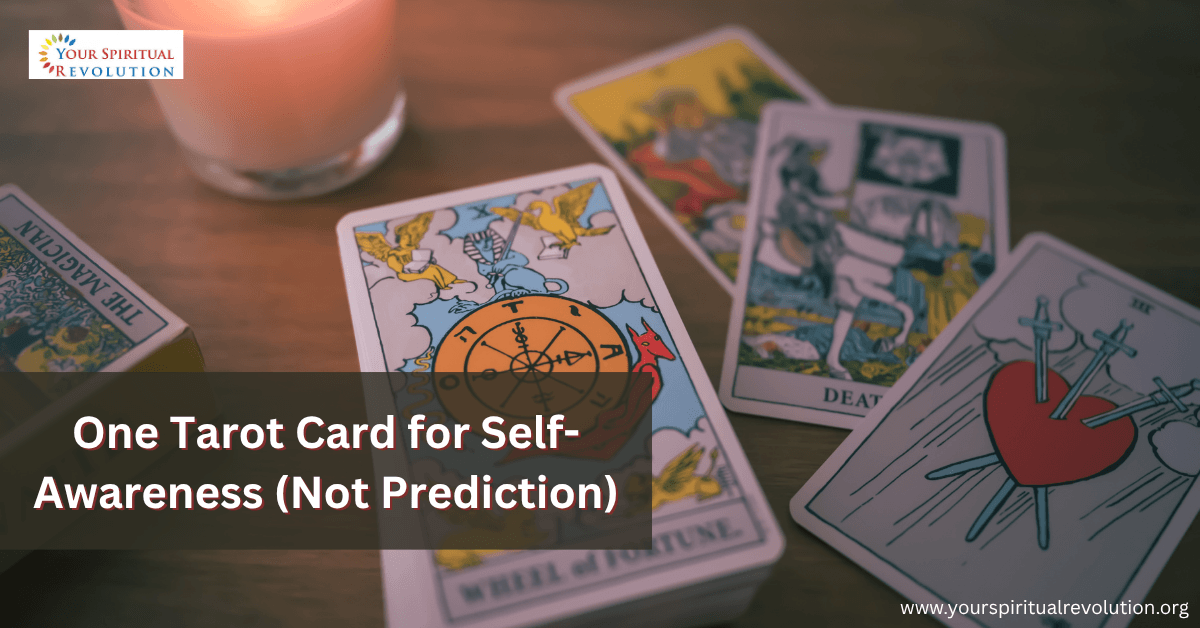
There are seasons when looking inward produces nothing, because you are too close to the situation to see its shape. This is where reflective traditions earn their place. Tarot, the I Ching, and structured journaling prompts all
work the same way: they introduce an image or a question you would not have chosen, and that friction breaks the loop.
The value is not prediction. It is being handed a frame from outside your own head. Many people now use guided tarot reflection for this, drawing a card and sitting with what it surfaces rather than asking it what will happen.
Used this way, the practice is closer to contemplation than divination.
6. Notice what you avoid
Keep a short list of subjects you steer away from. Not dramatic ones, necessarily. A person you have not replied to. A decision you keep restating instead of making. A question about money or health you have not looked at directly. Avoidance is the most reliable map of where your growth is currently blocked.
7. Close each day with a single honest sentence
Not gratitude, unless gratitude is honest. One sentence about what was actually true today. “I was impatient with my mother and I knew it while I was doing it.” Written without justification and without resolution. Over weeks this builds a record of self-observation that no amount of reading produces.
Why small practices outperform large ones
The spiritual literature is full of demanding disciplines, and they work for people whose lives are arranged around them. For everyone else, the practice that survives contact with an ordinary week is the one that changes anything.
Each of the seven above takes under ten minutes. None requires belief in anything in particular. What they share is a single mechanism: they interrupt automatic thought long enough for you to see it happening.
That is most of what self-awareness is. Not insight arriving from elsewhere, but a small gap opening between what happens and how you respond, and that gap widening slowly, over years, through repetition.
Start with one
Choose the practice that produced the strongest reaction as you read, including irritation. Irritation is usually recognition arriving early. Run it for two weeks without evaluating whether it is working. Evaluation is its own form of avoidance.
Then, if it has held, add a second.